Art in Bloom Workshop Spotlight
Updated: Jun 10
The Art of Natural Dyeing: A Conversation with Artists Karen Stewart Brown & Carey Stoudt.
Indigo blue. Printed leaves. Flowers transferred directly to cloth. The world of natural dyeing is equal parts art, science, craft, and discovery.
For more than two decades, artists and designers Karen Stewart Brown and Carey Stoudt have explored the intersection of color, pattern, nature, and textile traditions such as Indigo Shibori, Hapa Zome, and Botanical Printing. During Art in Bloom, June 12–13, 2026, they'll bring these creative practices to the Center for the Arts through a series of immersive workshops designed for artists, gardeners, makers, and anyone inspired by the beauty and creative possibilities of the natural world.

Ahead of the workshops, we sat down with Karen and Carey to talk about the history of Shibori, the beauty of working with plants, and the unexpected moments that make natural dyeing so captivating.
The two first met while working in the design department at Patagonia. Karen, a painter trained at the Maryland Institute College of Art (MICA), arrived after design roles with J.Crew, Free People, and Anthropologie. Carey came to Patagonia fresh from the Rhode Island School of Design (RISD), where she studied textile design and printmaking. What began as a professional collaboration quickly became a lasting friendship and creative partnership.
Their paths crossed again a decade ago when Karen moved to New Hampshire to lead design at Garnet Hill and invited Carey, who had relocated to Vermont, to collaborate on textile design projects. Today, they continue to work together through Assembly of Good, a creative collective dedicated to bringing people together through art, sustainability, and meaningful shared experiences.
This summer, Karen and Carey will lead a series of workshops exploring the rich traditions of Indigo Shibori, botanical printing, and Hapa Zome—hands-on processes that transform natural materials into beautiful works of art while deepening our connection to the natural world.

Q: How were you first introduced to natural dyeing, and what drew you to it?
A: My introduction to natural dyeing came through a lifelong fascination with color, textiles, and the natural world. As a painter, I have always been interested in how color behaves, and as a designer working in fashion and sustainability, I became increasingly curious about where color comes from and the impact it has on people and the environment.
“Natural dyeing is a beautiful intersection of art, craft, science, and nature. It slows you down and reconnects you to the source of the materials in a way that modern manufacturing often doesn't.”
Q: Indigo Shibori has a long and fascinating history. Can you tell us a little about where the practice originated and why it continues to captivate artists today?
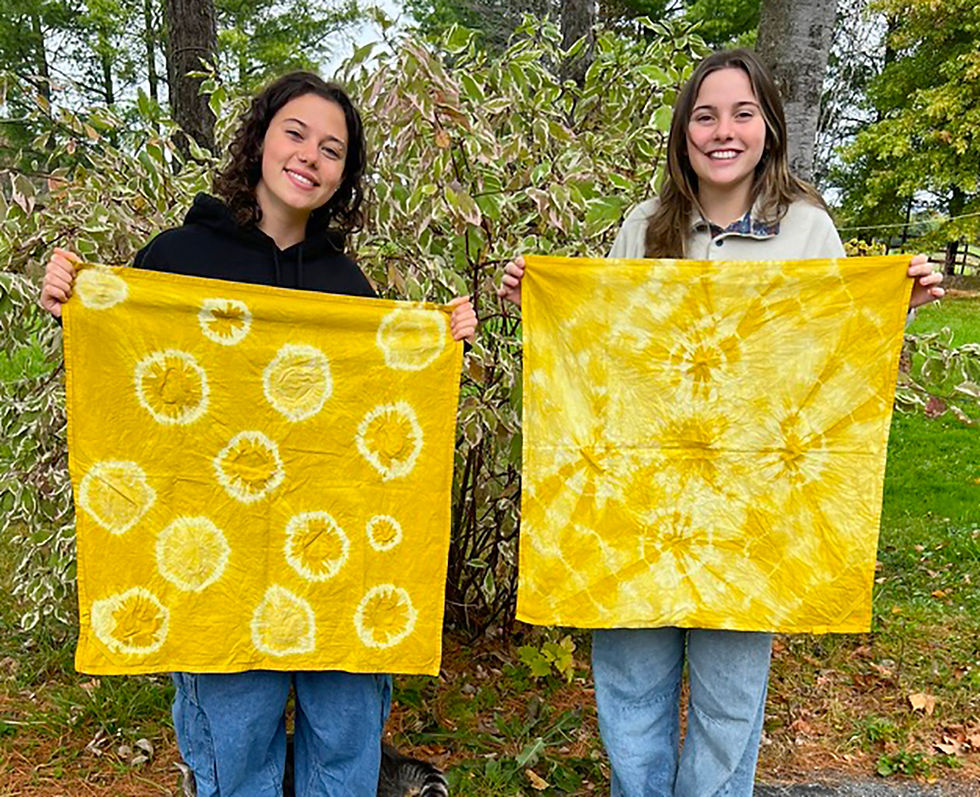
A: Shibori originated in Japan more than a thousand years ago as a method of resist dyeing cloth through folding, twisting, stitching, binding, and compressing fabric before dyeing. Indigo became one of the most widely used dyes because it was abundant and produced such rich, lasting color.
What continues to captivate artists is the balance between intention and surprise. You can carefully plan a pattern, but when you unfold the cloth, there's always a moment of discovery. It's a process that feels both ancient and endlessly contemporary.

Q: What makes natural dyes different from synthetic dyes, both visually and creatively?
A: Natural dyes have a depth and complexity that is difficult to replicate synthetically. The colors often feel softer, more nuanced, and more connected to the landscapes they come from. They are the colors we encounter throughout nature, and our attraction to them is rooted in both memory and experience.
The unique pigments and tannins found in plants create multidimensional colors that seem to shift and glow in changing light. Natural dyes are also inherently unpredictable. Every season, plant, water source, and dye bath can produce slightly different results, making experimentation and discovery part of the creative process.
Synthetic dyes, by contrast, are engineered for consistency, precision, and permanence. They produce exact, repeatable colors and can penetrate almost any fiber. In my own textile work, I often combine naturally dyed fabrics with upcycled synthetically dyed materials, using the contrast between the two to create visual tension and depth.

Q: For someone who has never tried Shibori or botanical printing before, what surprises them most about the process?
A: People are often surprised by how accessible the process is and how quickly they can create something beautiful. They're also surprised by the sense of wonder it inspires.
Both Shibori and botanical printing involve folding, binding, bundling, or arranging materials in ways that create unexpected patterns and mirrored forms. There is always an element of discovery.
"Opening a Shibori piece or unwrapping a botanical print feels a bit like opening a gift—you never know exactly what will be revealed."
Even people who don't consider themselves artists often leave feeling inspired, confident, and eager to continue exploring.
Q: Hapa Zome is sometimes described as "painting with plants." What do you love most about this technique?
A: I love the direct connection between the plant and the cloth. There is no intermediary. The flower, leaf, or petal transfers its own color, shape, and character directly onto the surface. Every plant leaves a different signature.
Hapa Zome encourages curiosity and observation. You begin to notice the details, textures, and colors of plants you may have walked past a hundred times before.

Q: How much of the final result is intentional, and how much is left to chance?
A: It's always a conversation between the maker and the material.
We make intentional choices about fabric selection, mordanting, folding, binding, composition, and plant placement. Keeping detailed dye notes can also help guide future results. But nature always has a vote.
Like a fingerprint, every plant has a unique chemical makeup that changes throughout the growing season. Those variations influence the colors and impressions that appear on the fabric. Some of the most beautiful results happen when something unexpected occurs. Learning to welcome those surprises rather than resist them is part of the joy of working with natural dyes.
Q: What plants, flowers, or natural materials produce your favorite colors and impressions—and why?
A: Indigo will always hold a special place for me because of the incredible depth and vitality of its blue. For botanical printing, I love working with sumac, eucalyptus, maple leaves, ferns, cosmos, coreopsis, marigolds, roses, and whatever happens to be growing locally and seasonally.
Sumac is one of my favorites because of the remarkable range of colors it produces throughout the season. Its leaves also create beautiful, printed forms that add movement and rhythm to the fabric.
"What I enjoy most is that every plant tells a different story. Materials gathered from meaningful places become more than design elements—they become lasting reminders of a particular landscape, season, or moment in time."
Q: Beyond creating beautiful artwork, what do these processes teach us about nature, patience, and paying attention?
A: They teach us to slow down.
We live in a culture that often values speed, efficiency, and control, but natural dyeing operates on nature's timeline. The process asks us to observe carefully, be present, and trust what unfolds.
Working with plants has deepened my appreciation for the extraordinary complexity and beauty of the natural world. It has also reinforced the importance of balance in my own life. Much of my textile work is inspired by landscapes in rural Vermont, and the resulting pieces become abstractions of moments spent observing and connecting with those places.
"Natural dyeing reminds us that beauty often emerges through patience, curiosity, and a willingness to pay attention."
Q: What is the most memorable or meaningful piece you've created using Shibori, botanical dyeing, or Hapa Zome?
A: Some of my most meaningful pieces aren't necessarily the most technically perfect. They're the pieces that capture a place, a season, or a particular moment in time.
One that stands out was created using plants collected along the rocky coastline of Maine, a landscape that has inspired my painting for years. Every time I look at that textile, I'm transported back to that shoreline—the colors, the textures, the feeling of being there.
The piece became more than a textile. It became a memory preserved in cloth.
Q: What do you hope participants take home from the workshop—beyond the pieces they create?
A: I hope they leave with a renewed sense of creativity and possibility. I want them to realize that making doesn't require perfection and that art can be playful, experimental, and deeply rewarding.
"Most of all, I hope they leave feeling more connected—to nature, to themselves, and to the people around them. The workshops are as much about community, curiosity, and shared experience as they are about the finished pieces we create together."
CREATE WITH NATURE
Art in Bloom Workshops with Karen Stewart & Carey Stoudt
Transform leaves, flowers, and natural dyes into beautiful works of art. During Art in Bloom, artists Karen Stewart and Carey Stoudt will lead immersive workshops in Indigo Shibori, Botanical Printing, and Hapa Zome, sharing techniques that have captivated artists for generations.
Experience the wonder of unfolding a Shibori textile, revealing a botanical print, or discovering the colors hidden within plants. No experience is necessary—just curiosity and a willingness to explore.
Upcoming Workshops
Botanical Printing & Hapa Zome Textile Workshop
Friday, June 12 | 2:00–5:00 PM
Explore botanical printing, plant impressions, and Hapa Zome ("painting with plants") while creating unique textiles inspired by the natural world.
Space is limited and advance registration is recommended.
Indigo Shibori Textile Workshop — Pattern, Process & Connection
Saturday, June 13 | 10:00 AM–12:00 PM
Discover the centuries-old Japanese art of Shibori and create beautiful indigo-dyed patterns through folding, binding, and resist-dye techniques.
Space is limited and advance registration is recommended.