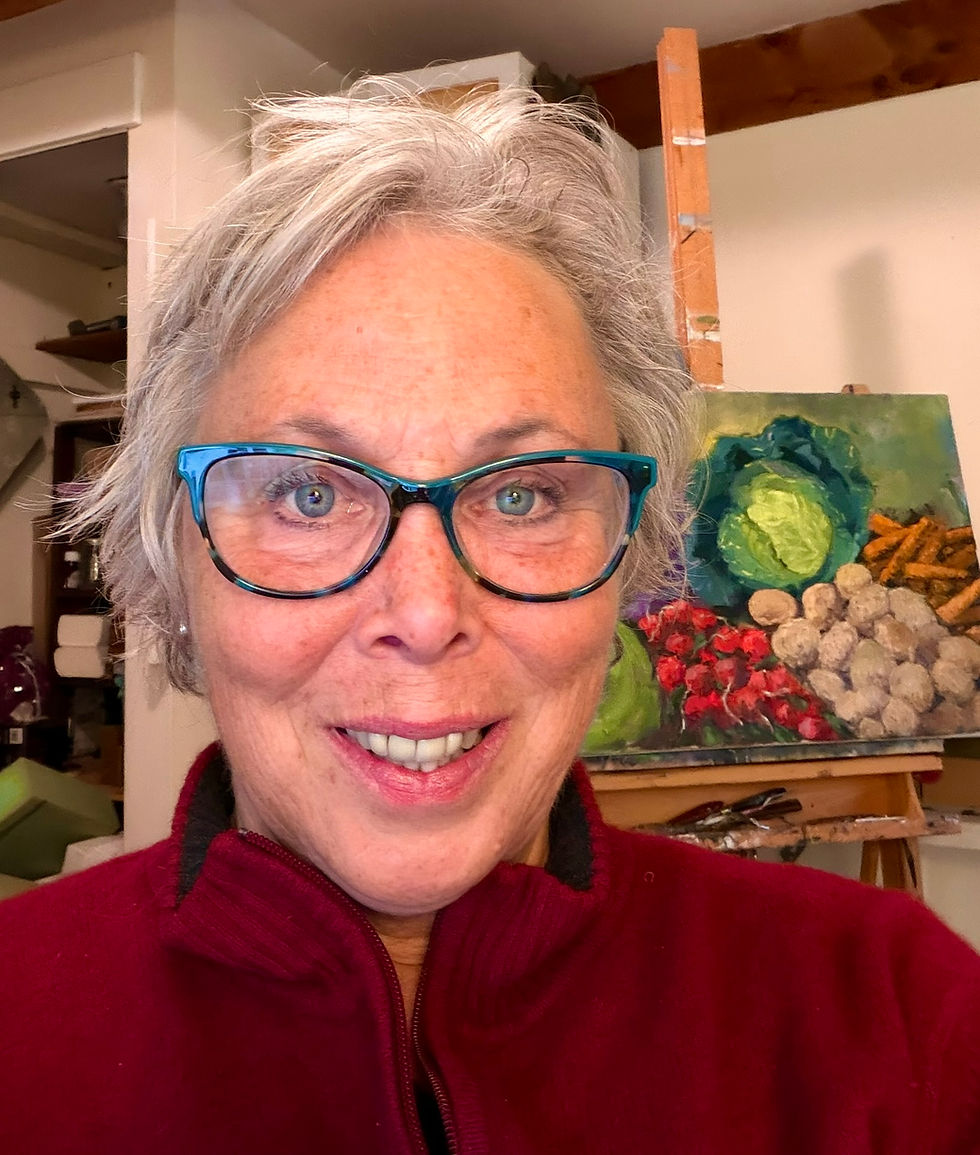
A Conversation with Peter Anderson
After more than two decades of maintaining a studio practice in New Hampshire, artist Peter Anderson is preparing for a new chapter in Tubac, Arizona — a nationally recognized arts community known for its galleries, studios, and creative culture.

Peter has been an important part of the creative fabric of this region for many years — as an exhibiting artist, educator, and longtime member of the CFA community. Before relocating this summer, Peter will be opening his studio for a special sale of paintings, monoprints, and limited-edition works.
We recently sat down with Peter to talk about process, memory, landscape, New Hampshire, and what comes next.
Q: You’ve built a life that spans business, international work, and a decades-long art practice—how have those worlds shaped the work you’re making today?
A: I didn’t set out to connect those worlds, but they’ve folded into each other over time. The business side taught me how to build systems and live with uncertainty. The international work—especially time spent in Japan—sharpened my sensitivity to space, restraint, and the idea that meaning doesn’t have to be stated to be felt.
In the studio, that all shows up as a balance between structure and unpredictability. I build a framework—materials, scale, a way of starting—and then let the work move. It’s less about control and more about setting conditions and paying attention to what happens.

Q: You’ve maintained a working studio in New Hampshire for over 20 years—what has this region given you as an artist, and what will you carry with you as you leave?
A: New Hampshire gave me time. That’s the biggest thing. Time to build a practice slowly, without a lot of noise around it.
The landscape matters too—not in a literal sense, but in the way it holds space. There’s a kind of quiet here that lets things surface gradually. I think that shows up in the work as restraint and pacing.
What I’ll carry is that rhythm—the sense that things don’t have to resolve quickly. That recognition comes later, if it comes at all.
Q: Your “combines” bring together monoprinting, drawing, painting, and collage—what draws you to working across disciplines rather than within a single medium?
A: It’s less a decision and more a necessity. No single medium quite does what I need it to do.
Monoprinting introduces chance. Collage brings structure. Drawing helps me find connections after the fact. Painting lets things settle or open up again.
Each part solves a different problem, and the work happens somewhere in the overlap. If I stayed inside one medium, it would feel too resolved, too early.
Q: Much of your work explores remembered and imagined landscapes—how do memory and place interact in your compositions?
They’re not separate. What I’m working with isn’t a specific place so much as the residue of having been somewhere.
A shape might come from a hillside, or a color from a certain kind of light, but by the time it gets into the work it’s already been altered. Memory simplifies, distorts, and rearranges.
So, the compositions become something like a map that doesn’t quite line up—a place you recognize without being able to name.
Q: What role has the Center for the Arts played in your creative life here, and how has being part of this community influenced your work?
A: CFA has been a kind of anchor. It creates a place where artists can show work, teach, and stay connected to a larger conversation.
That kind of infrastructure matters more than people realize. It allows a practice to extend beyond the studio.
Being part of that has kept me engaged and, at times, pushed me to articulate what I’m doing more clearly.
Q: From your perspective, what makes CFA an important platform for artists in this region—both for those just starting out and those deep into their practice?
A: It meets people where they are.
For emerging artists, it provides access—places to show, opportunities to learn, a way into the community. For more established artists, it offers continuity and a chance to contribute back.
That range is what makes it work. It’s not one thing—it’s a system that supports different stages of a practice.
Q: As you prepare to leave the region, how are you thinking about this moment—does it feel like a closing chapter, a transition, or something else entirely?
A: It feels more like a transition than a closing.
Nothing really ends cleanly—it just shifts context. The work continues, but in a different landscape, with different conditions.
So I’m thinking of it less as leaving something behind and more as carrying it forward into a new setting.

Q: You’re teaching two classes at CFA before you leave—what specifically will participants learn, and who are these classes really for? Beginners? Experienced artists?
A: They’re for both, but for slightly different reasons.
The mixed media class is very hands-on—people will learn how to build layered surfaces using monoprinting, collage, and drawing. It’s approachable for beginners, but it also tends to open things up for more experienced artists who may feel stuck in a single way of working.
The second class—on organizing an art practice—is less about making and more about sustaining a practice over time. That’s useful at any level, because most artists are figuring that out as they go.
Q: What techniques or approaches from your own studio practice will you be sharing in these classes that people won’t easily find elsewhere?
A: The main thing is process—specifically how to work without knowing exactly where you’re going.
In the studio, I use a method I call “Rock/Paper/Scissors”—it’s a way of moving between making, disrupting, and reassembling. It creates a kind of productive tension where unexpected things can happen.
That’s not something you usually learn from a book. It has to be experienced.
Q: If someone experiences your work or takes your class in the next few weeks, what do you hope stays with them after you’ve gone?
A: A sense that it’s okay not to know exactly what something means.
That you can work from intuition, from fragments, from things that don’t quite resolve—and that something will still come through.
Not as a message, but as a kind of recognition.
Q: If someone has been curious about your work—or about mixed media more broadly—why is now the moment to take one of your classes?
A: Because it’s a moment of transition—for me, and maybe for them too.
There’s a certain openness that comes with that. The classes won’t be about mastering something as much as entering into a way of working and seeing what unfolds.
And practically speaking, it’s also the last chance to do this work with me here in this space.
To view more of Peter's work, visit his website: https://www.peterandersonstudio.com